
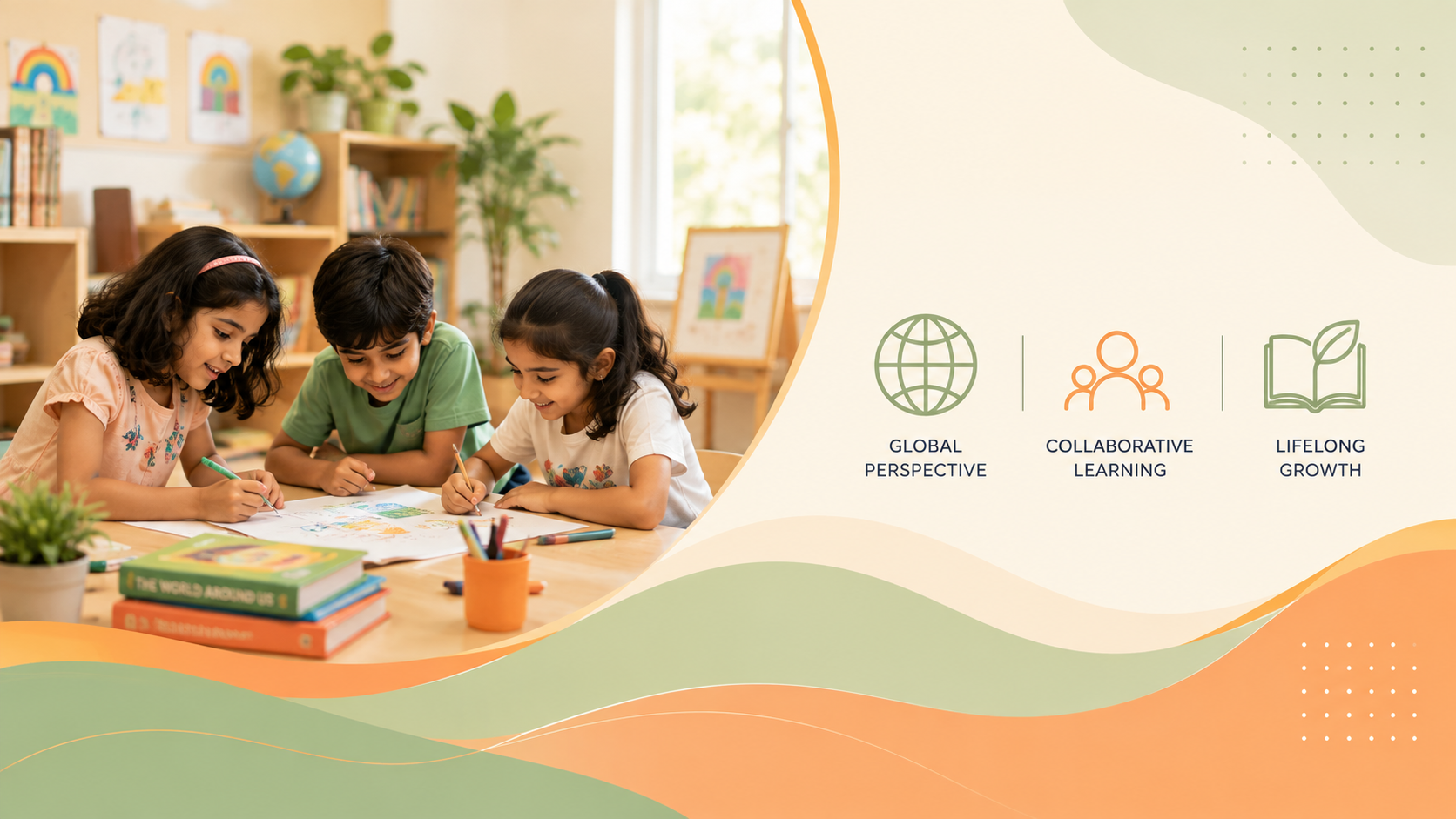
There is a particular kind of learning that happens when a student reads about how a bridge is engineered, and a very different kind that happens when the same student builds one, watches it hold weight or fail, and works out why. Both involve the same content. Only one of them tends to stay with a child for years afterward. This is the basic premise behind experiential learning, and it sits at the centre of how Heritage approaches education.
What Experiential Learning Actually Means
Experiential learning is often reduced, in casual conversation, to field trips and hands-on activities. Those are part of it, but the model runs considerably deeper than that. At its core, experiential learning is built around a simple cycle: a student does something, reflects honestly on what happened, concludes that reflection, and then applies the conclusion to the next attempt.
This cycle is quite different from the more familiar pattern of being taught a concept, memorising it, and reproducing it in an examination. It asks more of a student in the moment, and it asks more of a teacher in how a lesson is designed. But it produces an understanding that tends to be more durable, because the student has genuinely worked for it rather than simply received it.
How This Looks Inside the Classroom
At Heritage, a concept in physics is not simply explained on a whiteboard. Students are more likely to encounter it first through an experiment they design themselves, including the parts that do not work as expected. A history lesson on a period of conflict may involve a structured debate where students must argue a position they do not personally hold, forcing them to genuinely understand a perspective rather than dismiss it.
This approach extends across the curriculum, not only the sciences. A language class might involve producing a piece of creative writing intended for a real audience rather than a teacher alone. A mathematics unit might be anchored in a real world problem, such as budgeting for a community project, rather than an abstract set of equations. The content covered is the same as any rigorous curriculum. The route to understanding it is different.
Why Reflection Is the Most Important Step
The step most schools skip, even ones that do incorporate activity based learning, is structured reflection. It is easy to have students build something or run an experiment. It is harder, and considerably more valuable, to build in genuine time for a student to articulate what they learned, what surprised them, and what they would do differently.
At Heritage, this reflective step is treated as a core part of the process rather than an optional add on at the end. Students are regularly asked to document their own learning journey, not just their final output. This habit, practised consistently over years, is part of what allows students to become independent learners rather than students who simply follow instructions well.
Learning by Doing Builds More Than Knowledge
The experiential model does more than deepen understanding of a subject. It builds resilience, because a student who designs an experiment that fails has to sit with that failure and work out why, rather than simply being told the correct answer. It builds initiative, because open ended projects require a student to make genuine decisions rather than follow a fixed set of steps. It builds honest self assessment, because reflection only works if a student is willing to be truthful about what did not go well.
These are precisely the capacities that mark out the strongest applicants at universities worldwide, and precisely what employers describe when asked what a good education should have produced. They are also, not incidentally, the capacities that a fulfilling working life tends to require.
Seeing the Model in Practice
Among top IB schools in pune, Heritage has built its entire academic culture around this experiential approach, from the earliest years through to the diploma programme. It is not a supplementary programme layered on top of a conventional curriculum. It is the way the curriculum is taught.
The best way to understand what this looks like is to see it directly, in a classroom, on a normal day. We would be glad to show you. You can begin your IB school admission in Pune whenever you are ready, and our admissions team will guide you through every step of the process.